
Local SEO, explained for tradesmen
Seven things costing joiners jobs on Google, and the fix for each
The short answer
The seven we find most often are an unclaimed or unverified listing, a vague primary category, a service area drawn round the wrong place, no recent reviews, a phone number that rings out, a website that never names the towns, and nothing on the page that tells Google which trade you actually do.
Where this list comes from
These are the seven things we find most often when we look at a trade business on Google. Not a general list of SEO tips. The actual faults, in the order they cost you work.
Each one has the symptom, what it costs you, and the fix. None of them needs an agency to do it, and you can check all seven on your phone in about ten minutes.
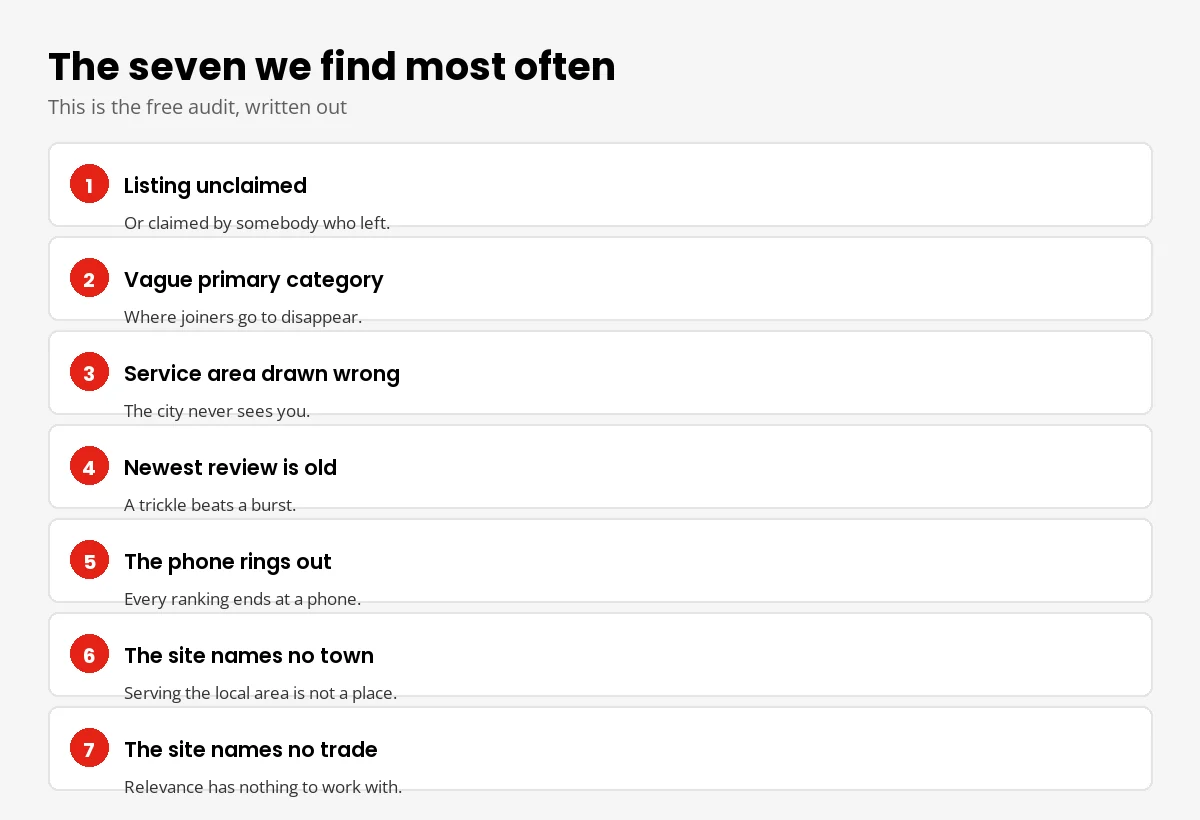
1. The listing is unclaimed, or claimed by somebody who left
An unclaimed listing can still show your business, usually with the wrong hours and no photographs. A claimed one you cannot get into is worse, because you can see the problem and not touch it.
The fix. Claim it, or start Google's recovery process if somebody else holds it. Nothing else on this list works until this does.
2. The primary category is vague
Google leans hard on the first category you pick. "Construction company" and "Home improvement" are where joiners go to disappear.
The fix. Set the primary category to the plainest word for your trade, and put the rest in as secondary categories rather than fighting over first place.
3. The service area is drawn round the wrong place
Distance is one of the three things Google says decides local results, and it measures from where it thinks you are. Work out of a village, serve the city, and searches from the city centre may never reach you.
The fix. Set the service area to the towns you will genuinely drive to, and name those same towns on your website so the two agree.
4. The newest review is months old
Prominence is the third factor Google names, and reviews are the part of it you control. A steady trickle beats a burst of ten followed by silence.
The fix. Ask on the day the job finishes, while they are still pleased with it, and send the review link by text rather than explaining where to find it.
5. The number rings out, or goes to a voicemail nobody checks
This one is not really SEO, and it is the most expensive fault on the list. Every ranking you gain ends at a phone somebody has to answer.
The fix. Decide what happens to a call you cannot take on a roof, whether that is a mate, a diverted number or a text back the same hour. Then make sure it actually happens.
6. The website never names a town
"Serving the local area" is not a place. If the towns are not written down, Google has nothing to match a local search against.
The fix. Name the towns in the first paragraph and again in the page title. Do not build a separate thin page for every village, which is the mistake that follows this one.
7. Nothing on the page says which trade you do
Plenty of trade sites open with "quality workmanship" and "over 20 years" and never say the word joiner. Relevance is the first of Google's three factors, and it has nothing to be relevant to.
The fix. Say the trade in the heading, in the first sentence and in the title. Use the word your customer would type, not the one on your invoices.
What is fixing them actually worth?
On the Liverpool joinery account we run, this is roughly the list we worked through. Here is what the six months from January to June 2026 looked like afterwards, with no ads running at any point.
- Profile views: 4,194
- Searches he appeared in: 1,014
- Calls straight from the listing: 136
The first month is where most of the movement happened, and faults one to three were the bulk of it.
Your town is not his town and your numbers will not be his numbers. The point is that the list is short, it is ordinary, and nothing on it is beyond a busy tradesman with an hour on a Sunday.
The mistake that usually follows
Once a trade realises towns matter, the temptation is to build a page for every village within thirty miles, each one the same text with the name swapped.
Google treats that as what it is, and pages built that way tend to earn nothing while making the site harder to read. We have seen it sink sites that were otherwise fine.
Build the towns you genuinely work in, give each one something true that only applies there, and stop. Four real pages beat forty copies every time.
Which one should you do first?
In this order, and stop when you run out of Sunday.
- Claim the listing.
- Fix the primary category.
- Fix the service area.
- Sort out what happens to a missed call.
- Start asking every finished job for a review.
- Put the trade and the towns on the website.
If you would rather somebody ran the seven on your business and sent you the list, that is exactly what our audit is. We will tell you what we find whether or not you ever work with us.
This is what the work involves, and we cover Manchester and the North West.