
Local SEO, explained for tradesmen
How long does local SEO take to work for a tradesman?
The short answer
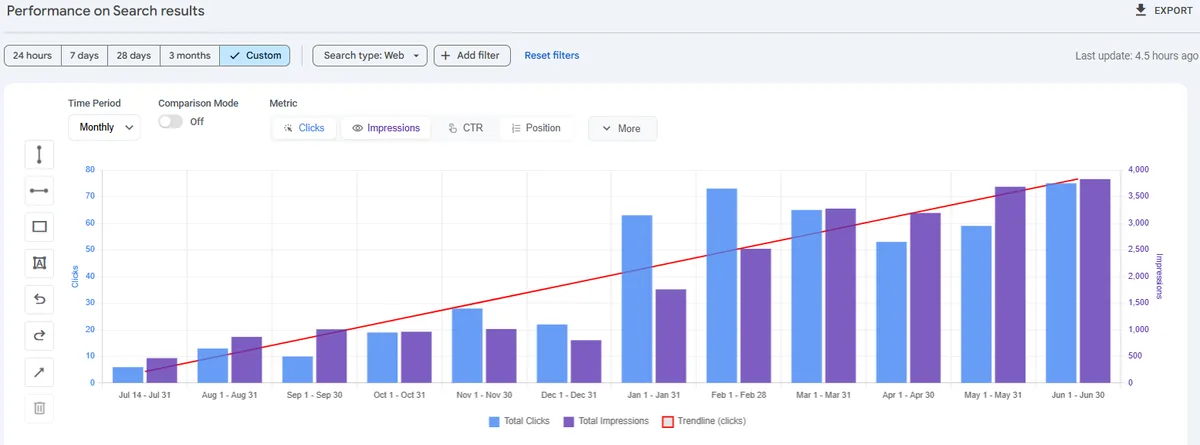
Weeks for the map, months for the website. On the Liverpool joinery account, visibility doubled inside the first 30 days and every key search term was in the top three within 90. The website is slower: its monthly clicks went from 5 to over 70 across twelve months, with no ad spend.
Why nobody gives you a straight answer
Ask ten agencies and you will get "three to six months" ten times, because it is the safest thing to say.
It is also not one question. The map results and the website move on completely different clocks, and most of the frustration in the first few months comes from expecting them to move together.
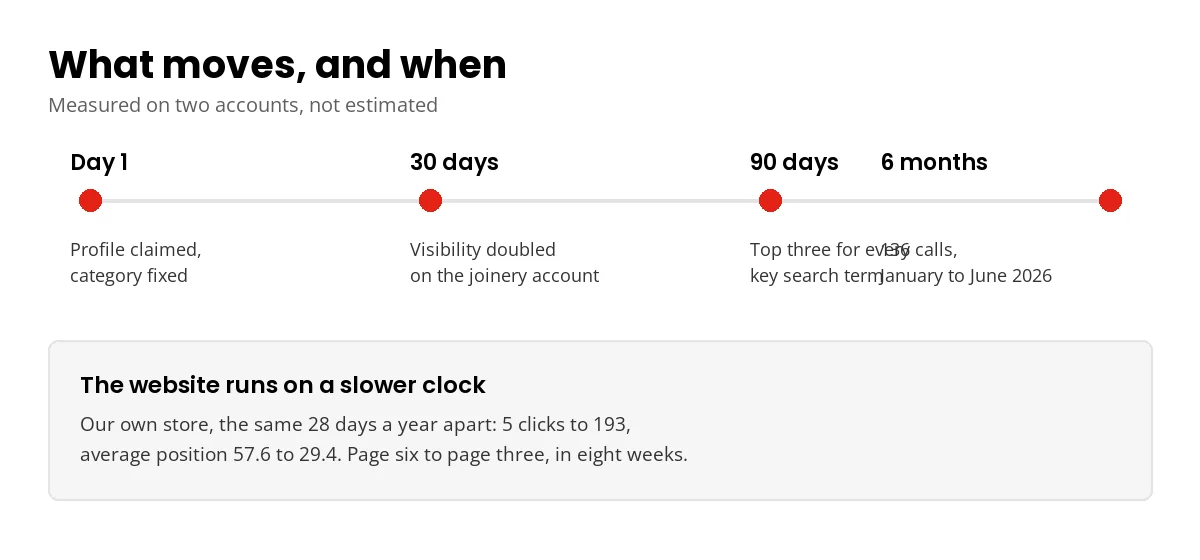
The map moves in weeks
Your Google Business Profile is the fastest thing you own. Fix the category, the service area and the details, and the change can show within days.
On the Liverpool joinery account we run, visibility doubled inside the first 30 days. Every key search term was in the top three within 90.
That is not typical of SEO generally. It is typical of a trade whose profile had never been set up properly, which describes most of the ones we look at.
The website moves in months
Ordinary search results are slower, because Google has to recrawl the pages, work out what changed, and then see whether people who click stay.
Months, not weeks, and the first thing that moves is usually not the thing you are watching. Google has to find the page, decide it is worth keeping, work out what it is about, and then see whether the people who click on it stay. Each of those is a separate step and each one can stall on its own.
So the order things happen in is rarely the order you would choose. Pages get crawled and indexed before any of them rank. The rankings that arrive first are the long, specific searches, the ones with a place name or a problem in them, rather than the two-word phrase you actually care about. A site can be making real progress for six weeks and show nothing at all on the one search you keep typing in.
That is also why the early signs worth watching are not positions. It is whether the number of your pages Google has indexed is going up, whether impressions are climbing on searches you did not expect, and whether anyone is clicking. Those move before the ranking does.
That is the honest shape of it. Anyone putting a date on a position for a query they have not looked up is guessing, and a guess with a month attached to it is still a guess.
What does each stage look like?
Weeks one to four
The profile is claimed, verified, categorised and filled in properly. Reviews start arriving again. This is where the fastest movement happens, and where most of the first calls come from.
Months one to three
The website starts saying the trade and the towns. Pages get rewritten around what people actually search. Rankings start to wobble upward rather than jump, which looks like nothing happening and is not.
Months three to six
The map results settle, the review count is visibly ahead of the lads either side of you, and the enquiries change character. Fewer time-wasters, more jobs you actually want.
After six months
It compounds if you keep asking for reviews and keep the listing current. It slides back if everything stops, because the trades around you have not stopped.
What slows it down?
Three things, and two of them are ordinary.
- Verification trouble. A profile that will not verify, or one nobody can get into because an old web designer holds the account, can cost weeks before any work starts.
- Nobody asking for reviews. This is the part we cannot do for you. A trade who asks on the day of the job moves faster than one who means to get round to it.
- A crowded town. Twenty established joiners with hundreds of reviews between them is a harder start than a town with four, and it takes longer. It is still winnable, it just is not winnable by Friday.
When should you start worrying?
At 30 days, the profile should be verified, categorised properly and picking up reviews again. If none of that has happened, the delay is administrative rather than algorithmic, and it needs chasing.
At 90 days you should be able to see movement on a map scan even if the phone has not changed much yet. Rankings before calls is the normal order, not a warning sign.
At six months with no movement in profile views, searches or map position, something is wrong with the work rather than the timescale. That is the point to ask hard questions, and it is a reasonable thing to say out loud at the start.
How will you know it is working before the phone rings?
Calls are the point, but they are a lagging measure. The things that move first are profile views, the searches you turn up in, and where you sit on a map scan taken from different parts of your patch.
On the joinery account, a scan from 81 points across roughly 25 square miles of Liverpool put him in the top three at all 81, average position 1.28, on 3 February 2025. That is the kind of check that tells you something before the invoices do.
Ask whoever does your marketing for those three numbers every month. If they cannot produce them, they are not measuring the thing you are paying for.
The full numbers are here, and this is what the work involves. If you want to know what your own first 90 days would realistically look like, we will look at your listing and tell you.