
Local SEO, explained for tradesmen
Checkatrade or Google, where should a joiner get his next job?
The short answer
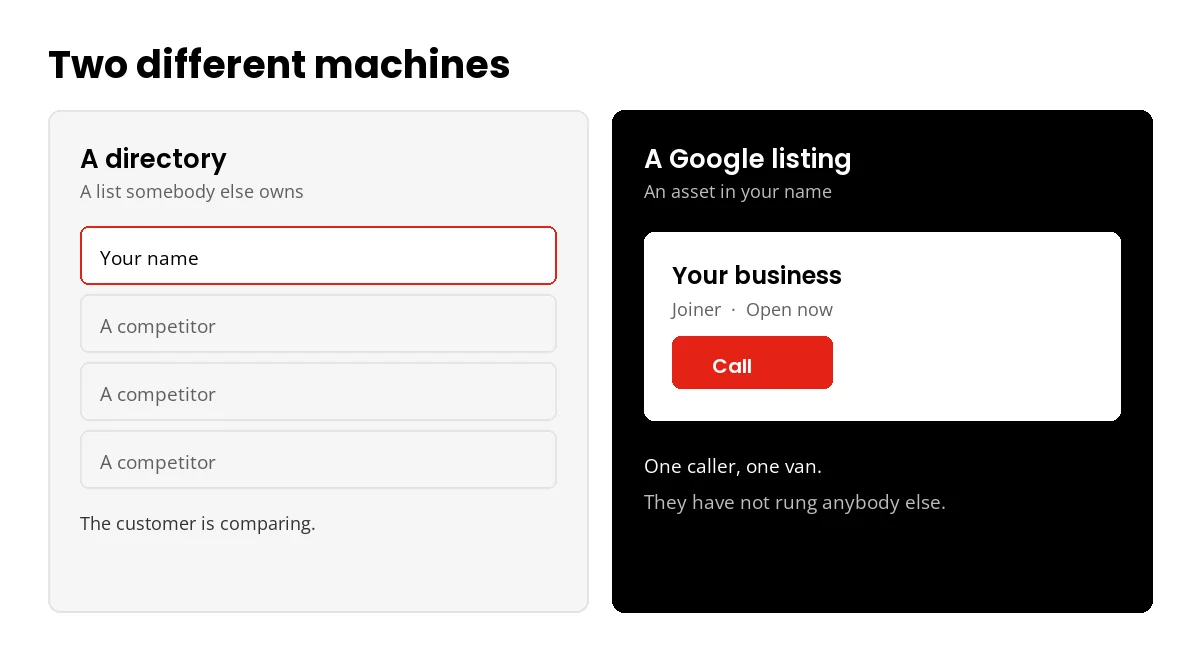
They are different machines. A directory rents you a place in somebody else's list, where the customer is choosing between you and the trades either side of you. A Google listing is yours, it sits in the map results for your trade and your town, and the person tapping it is ringing you rather than picking from a shortlist.
Why this question keeps coming up
Most joiners we speak to are already on a directory, already paying for it, and already unsure whether it is worth what it costs them.
Our own client put it plainly before we started working together.
"Before working with Scott, I was struggling with Checkatrade to attract serious customers. After using Scott's Google Maps services, I'm now able to select clients I want to work with, and I have plenty of projects to consider."
David, Independent Joinery, Liverpool. Published on our own site and quoted here in full.
That is one joiner's experience rather than a verdict on a company. What it does point at is the difference between the two machines, and that difference is worth understanding whichever one you use.
What a directory actually is
A directory is a list you pay to be in. Somebody else owns the list, sets the order, and decides what the page around your name looks like.
When a customer arrives, they are on a page built to help them compare. Your name sits beside other trades who do the same job in the same town, and the comparison is the point of the page.
That has real advantages, particularly at the start. You get found by people who would never have found you otherwise, and somebody else has done the work of getting them there.
The catch is that none of it is yours. Stop paying and the listing goes, and everything it built goes with it.
What a Google listing is instead
A Google Business Profile is an asset in your name. You control the trade it is listed under, the area it covers, the photographs on it and the replies underneath the reviews.
When somebody searches for a joiner in your town, the map results are the first thing they see, and the call button is on the result itself. They are not comparing a page of members. They are ringing a joiner.
Google's own help page says three things decide who appears there. How well the listing matches the search, how far away the business is, and how well known it is. Two of those three are yours to improve.
What actually differs, in practice
Who owns the caller
On a directory, the customer's relationship starts with the directory. On a Google result, it starts with you, and the review they leave afterwards sits on your listing where the next customer reads it.
What happens when you stop paying
A membership ends and the work it was doing ends the same day. A profile you have built up keeps ranking, because it was earned rather than rented.
What the customer is doing when they find you
A directory page is a shortlist by design. A map result is one business and a call button, which is a different frame of mind and a shorter conversation.
Whether it compounds
Reviews, photographs and consistency add up on a profile month after month. On a rented listing the meter simply starts again.
What did it look like when one joiner switched his effort?
Between January and June 2026, David's Google listing was seen 4,194 times, turned up in 1,014 searches, and produced 136 calls. No ads ran at any point.
The searches that found him were "joiners liverpool" and "joiner liverpool", with 414 and 252 behind them. Trade, then town, from people who had not yet rung anybody.
He is one joiner in one city, and your town has a different number of joiners in it. What carries across is that the calls came from an asset with his name on it.
How to decide with your own numbers
Take your last twenty jobs and write down where each one came from. Directory, Google, word of mouth, a van sighting, a repeat customer.
Then put two more columns beside them. What the job was worth, and how much haggling it took to win.
Most trades who do this find the split is not what they assumed, and that the cheapest enquiries and the hardest ones tend to arrive together. It takes twenty minutes and it beats any argument either of us could make.
So should you cancel the directory?
Not on the strength of a blog post, and not this month. If it is bringing you work you would otherwise not have, cancelling it before anything replaces it just makes a quiet month.
The sensible order is to build the thing you own while the thing you rent is still running. Claim the profile, get the category right, make reviews a habit, and give it a few months.
Then look at where your last twenty jobs came from and decide with numbers in front of you. That is a much easier decision than the one you are making now.
If you want to know what your Google listing is capable of before you change anything, we will look at it and tell you. Our results are here and the work is described here.